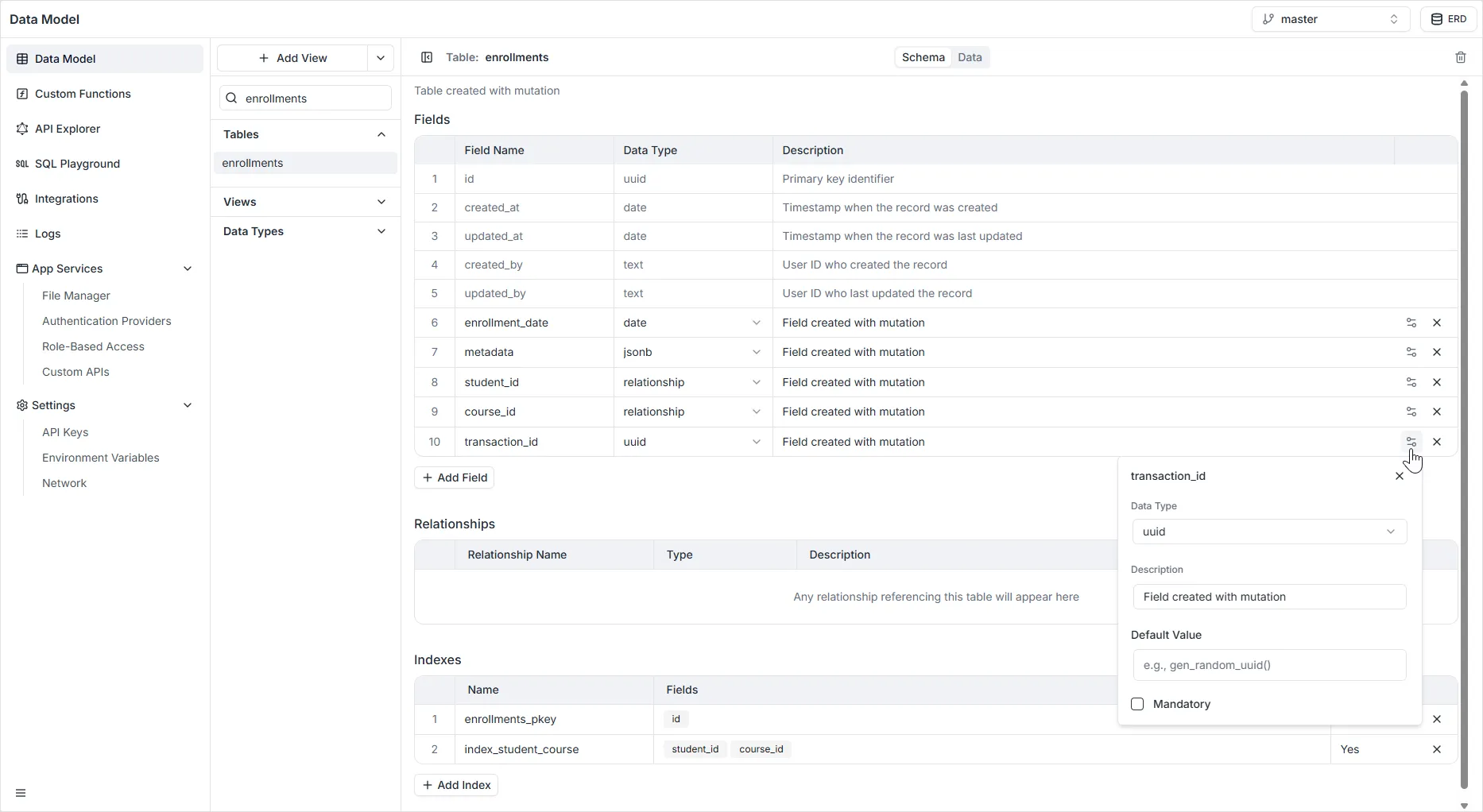
UUID Field
The UUID (Universally Unique Identifier) field is designed to store 128-bit unique identifiers.
Unlike a standard ID (which might be a simple number like 1, 2, 3), a UUID is a standardized string format (e.g., 123e4567-e89b-12d3-a456-426614174000) that guarantees uniqueness across different systems, databases, and servers without requiring a central coordination authority.
Configuration Properties
Section titled “Configuration Properties”When configuring a UUID field in the right-hand sidebar, the following settings are available:
- Name: The unique system identifier for the field (e.g.,
transaction_id,external_ref_id,invite_token). - Default Value: An optional specific UUID string to be used if no value is provided.
- Note: In most use cases, you will leave this blank, as UUIDs are typically generated dynamically by the application or API at the moment of creation.
- Description: An optional text box to describe the purpose of the identifier.
- Mandatory: If enabled, the record cannot be saved unless a valid UUID is provided.
- Unique: If enabled, ensures that this specific UUID appears only once in the entire table.
- Best Practice: It is highly recommended to enable Unique for UUID fields to maintain data integrity, especially if the field is used as a reference key or token.